The ultimate WordPress maintenance guide

Once a website is published, it’s tempting to think the job is done. Many clients see it that way too: it looks good, it works, so what else is left to do?
However, from a professional perspective, the work has just started.
A WordPress site runs on software and different moving parts that are constantly evolving. As a core digital asset for most businesses, it needs ongoing maintenance to keep everything running smoothly.
In that sense, it isn’t that different from a car. Nobody waits until it breaks down to change the oil. We take the car in for regular inspections to prevent failures and avoid bigger, more expensive problems later.
And yet, site care remains one of the services many freelancers and agencies struggle most to sell, even though they know it’s essential and a strong foundation for building stable, recurring revenue.
If you’re looking to better understand what WordPress maintenance involves and how to leverage it as a service your clients are happy to pay for, you’re in the right place. Let’s get into it.
Table of contents
Common signs of a poorly maintained WordPress site
We’ve all seen it at some point: a client site that hasn’t been updated in years, an expired SSL certificate, and issues that have piled up over time.
Some of the most common consequences of poor maintenance are easy to spot:
- The site keeps getting slower. Plugins accumulate, images aren’t optimized, the database grows without anyone cleaning it up… The result? Loading times start to suffer. And we all know visitors don’t wait around. If a page takes too long, they’re gone.
- Things stop working as they should. Usability issues begin to appear and make the site feel unreliable and unprofessional, like plugin conflicts, broken links, missing functionality, or outdated content.
- Security risks increase. Weak setups and outdated versions of WordPress, plugins, and themes leave the site exposed, making it an easier target for unauthorized access and malicious attacks.
- Search rankings begin to drop. As a result of all the above, search engines won’t like what they see, and the site starts losing positions. Once search visibility drops, recovering it isn’t quick or easy.
Benefits of ongoing WordPress maintenance
All of the above is what WordPress maintenance is meant to prevent. In practical terms, that means:
- Stronger security: Good maintenance practices are one of the best ways to reduce the risk of hacking attempts. Regular updates and monitoring protect sites against vulnerabilities and lower the chances of exploitation.
- Better performance: Google cares about speed and user experience, and so do users. Maintenance helps keep performance in check before issues start adding up and quietly affecting traffic and conversions.
- Proactive prevention: When you review your WordPress sites regularly, you catch issues early. Maintenance reduces downtime and errors before they turn into bigger problems, building client trust and strengthening your position as their go-to partner.
- Cost efficiency: This is the part that often gets underestimated. WordPress maintenance is always cheaper than emergency fixes, helping avoid higher costs later. Recovering a hacked site, restoring lost data, fixing SEO damage… all of that is expensive, in time, money, and reputation.
- Peace of mind: Knowing that your managed sites are backed up and running properly saves you time and stress in the long run. It also frees you up to focus on higher-value work instead of constantly reacting to problems.
What a WordPress maintenance service should include
WordPress core, plugin, and theme updates
Keeping WordPress core, plugins, and themes up to date is one of the most important maintenance tasks. As we’ve seen, both security and performance depend heavily on updates, as they introduce new features, fix bugs, and prevent issues.
That said, some can introduce compatibility risks or unexpected changes as well. That’s why it’s so important to know how and when to run them.
So, what should an update workflow typically include?
- Reviewing changelogs when it makes sense.
- Understanding the type of update (minor, major, security patch, etc.) and how urgent it is.
- Testing on a staging environment when needed.
- Making sure recent backups are in place before updating.
- Checking that everything works as expected afterward.
If you manage multiple client sites, there are many tools today that go beyond bulk updates, helping you run them safely with rollbacks and automate them to save time.
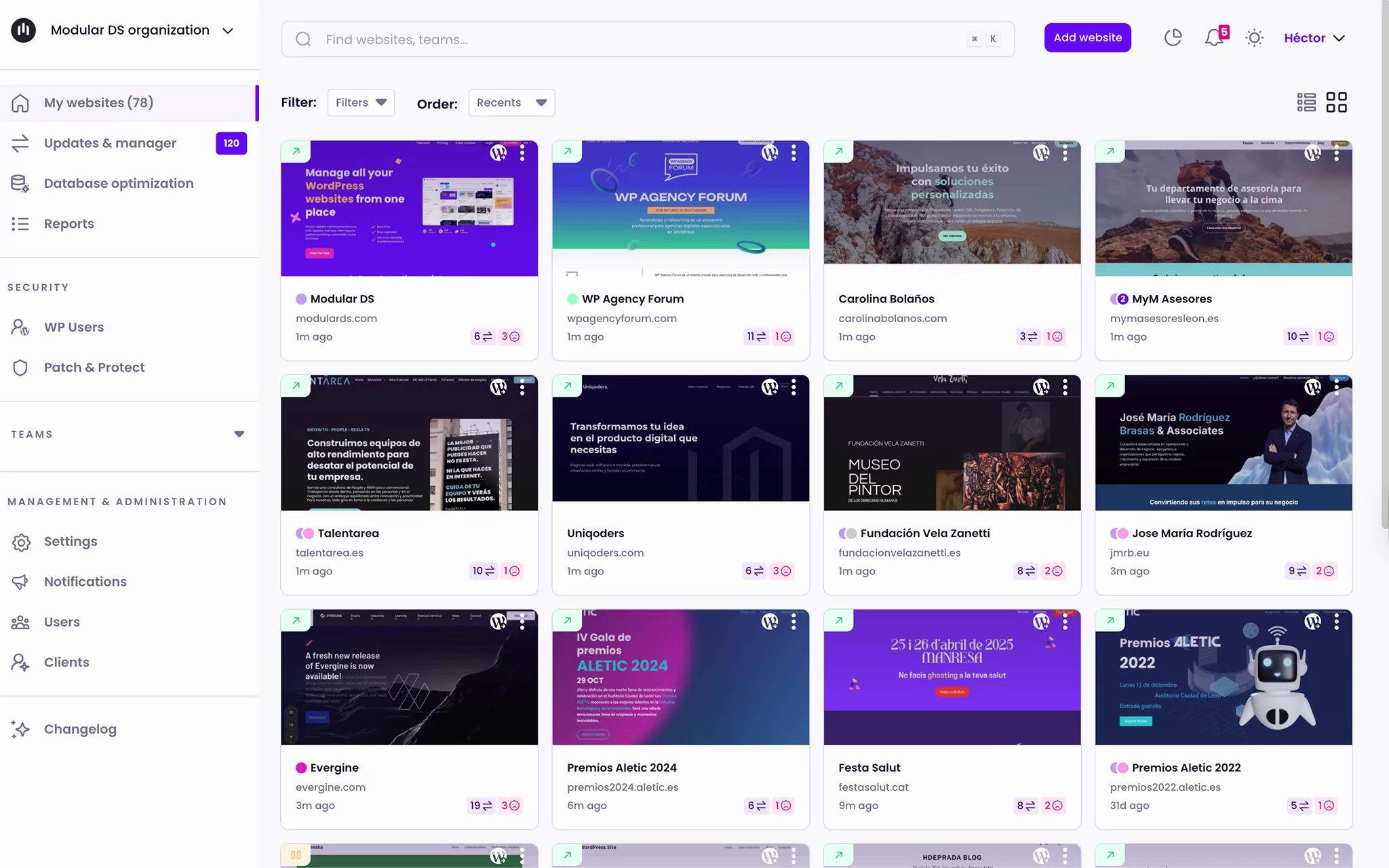
With Modular DS, for example, you can see risk scores and recommendations before updating, so you can make more informed decisions. Or even set smart automation rules so updates only run when certain conditions are met, giving you more control over the process.
Security and vulnerability management
If we look at the latest State of WordPress Security report, the numbers are hard to ignore: 11,334 new vulnerabilities were discovered in the ecosystem in 2025, a 42% increase compared to the previous year. Out of them, 91% were found in plugins, and 9% in themes. And the trend continues to grow as AI and vibe coding make it easier than ever to build and submit new plugins.
This doesn’t mean WordPress core is insecure (quite the opposite), but it does highlight how exposed third-party code can be.
Beyond regular updates, good WordPress maintenance means taking a proactive, layered approach to reduce risk before damage actually happens.
These are some tasks and best practices you can include in your care plans:
- Monitoring your managed sites for known vulnerabilities.
- Enforcing strong password policies and reviewing user roles, removing old or unnecessary admin user accounts.
- Reviewing server file and folder permissions.
- Setting up protection and mitigation rules (virtual patching).
- Running security audits and malware scans to detect and remove malicious code.
- Reviewing unusual login activity.
- Checking SSL certificate validity.
- Having an emergency response plan in place.
If you’d like to explore the topic further, we discussed layered security and prevention strategies in this free webinar with Patchstack.
Backups
A human mistake, a hacked site, a critical error… many things can accidentally break a site or delete important data. In those situations, being able to roll back saves time, money, and a lot of stress. That’s exactly why backups are a core part of any maintenance plan.
Both dedicated plugins and WordPress management solutions make it easy to integrate them into your routine, letting you define the frequency, the type of backup, and how long you want to retain them.
As a general rule, follow the 3-2-1 strategy: keep 3 copies of your data, store them in 2 different locations, and make sure at least one is off-site.
And just as important: test your restores (and ideally document the process). Having backups doesn’t help much if you or your team don’t know how to quickly restore them when you need them.
Monitoring and troubleshooting
Monitoring includes different tasks that help maintain site quality and troubleshoot problems before they negatively impact business results.
- Uptime monitoring: If a site goes down and no one notices until the client emails you, that’s already too late. Uptime monitoring helps you detect outages as soon as they happen so you can react quickly.
- Broken links (404 errors): Clicking on a link that leads nowhere is annoying, makes a site look outdated, and can harm SEO. As part of your care routine, you should automatically monitor your sites with tools like Modular DS, Google Search Console, or Dead Link Checker to identify errors and fix them.
- Contact forms: A form that stops working and goes unnoticed for weeks, or even months, is more common than you’d think. The problem is that those leads are gone. Site maintenance includes testing forms periodically to ensure they’re working and submissions are reaching the right inbox.
- Site analytics: Analytics can also act as a monitoring tool. Sudden drops in traffic, unusual behavior, or fewer conversions can be a sign that something isn’t working well. Keeping an eye on this data helps you spot patterns and investigate issues early.
Performance optimization
Unnecessary code, misconfigurations, content updates, images, and even design tweaks can slow a site down over time.
As part of any maintenance workflow, it’s important to regularly audit how the site performs across devices and connection speeds, keeping an eye on key metrics like Core Web Vitals, Time to First Byte (TTFB), or overall page size.
Use tools like PageSpeed Insights or Lighthouse from Google, or others like Pingdom or GTmetrix, to run tests and spot bottlenecks. The results will quickly show which areas need attention.
Don’t forget about database optimization either: another task often included in care plans to keep the site lean and free of unnecessary bloat.
SEO health
Search engine algorithms evolve quickly, and what worked a few months ago doesn’t always work the same way today.
While you don’t need to offer a full SEO (or AEO) strategy, some WordPress maintenance plans cover basic adjustments and ongoing checks to help maintain visibility.
This can include, for example, reviewing key pages periodically to ensure content is still accurate and relevant (also for AI search), updating meta titles and descriptions, monitoring indexing issues, and detecting broken internal links.
Maintenance reporting
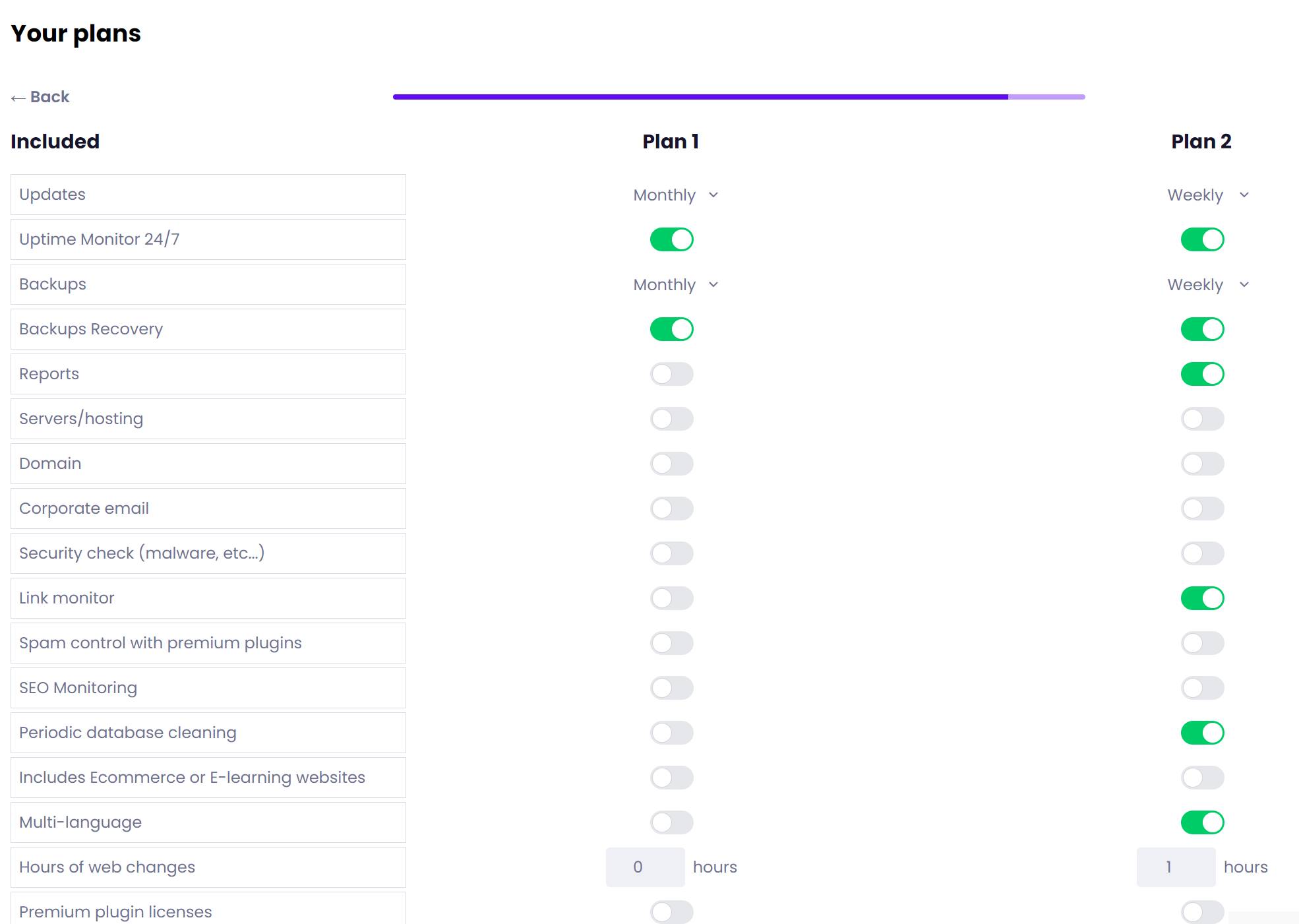
This is probably one of the most overlooked tasks of maintenance. You can do everything perfectly behind the scenes, but if your client doesn’t see it, they won’t value it. And even worse, they won’t understand why they’re paying for it.
Ongoing education and client communication are what turn all the “invisible” technical tasks into a professional service. How? Through maintenance reports that clearly show the value of your work, backed by data that supports the improvements made and the issues you’ve prevented along the way.
Among other benefits, consistent reports reinforce trust and strengthen client relationships, helping grow your recurring revenue.
Turning WordPress maintenance into a professional, scalable system
Everything we’ve covered makes sense when you’re managing a few WordPress sites. But once that number grows, the challenge is having a reliable, efficient system you can rely on to automate tasks, reduce risks, and scale a sustainable, profitable service.
A centralized setup allows you to:
- Reduce repetitive tasks and human errors.
- Save hours every week.
- Keep visibility across all your sites.
- Take on more clients without compromising service quality.
This is why all-in-one WordPress maintenance platforms like Modular DS exist. Instead of juggling multiple tools, they allow you to streamline all your tasks from one dashboard, with key features such as:
- Bulk management of plugins, themes, and WordPress core.
- Safe, scheduled, and smart automated updates.
- Backups and restores.
- Uptime monitoring with real-time alerts.
- Broken link and image checks.
- Vulnerability and malware scanning.
- Client management and automated reporting, including pre-maintenance reports.
- Database optimization across multiple sites.
- Integrations with Patchstack, Google Analytics, Search Console, WooCommerce, and PageSpeed.
If you feel it’s time to level up your maintenance services, you can explore Modular DS and see how it fits into your daily workflow. It’s free to try.

Final thoughts
Today, websites are being built faster than ever, more businesses are going online, and every single one of those sites will need ongoing care. That’s a huge opportunity for freelancers and agencies.
When built on the right processes and tools, WordPress maintenance can become one of the strongest pillars of your business, protecting your clients’ digital assets while strengthening your revenue.
With this guide, we hope you now have a clearer path to making the most of it. The next step is yours 😉