Are WordPress maintenance services worth it for freelancers and agencies?

WordPress maintenance services are worth it, but most freelancers and agencies don’t earn what they could from them. They offer some version of maintenance as part of post-launch support, but few treat it as a structured service that underpins their revenue. Framing maintenance as extra support rather than a core service keeps it from generating real recurring income.
Survey data backs this. The Admin Bar’s 2026 State of the WordPress Agency survey, with 622 agencies from 51 countries, found that recurring revenue marks the difference between struggling and thriving businesses.
This post covers what prioritizing maintenance does to your business, why most agencies stay stuck below the threshold where it pays off, and where the service is heading in 2026.
Table of contents
What prioritizing maintenance does to your business
Treating WordPress maintenance services as a real revenue line, rather than something you tack onto projects, changes three things: profitability, stability, and what you can sell next.
Recurring revenue is a clear predictor of profitability
Looking at the data from the Admin Bar survey, agencies with no recurring revenue are unprofitable 58% of the time. The pattern is clear when you group agencies by how much of their revenue is recurring:
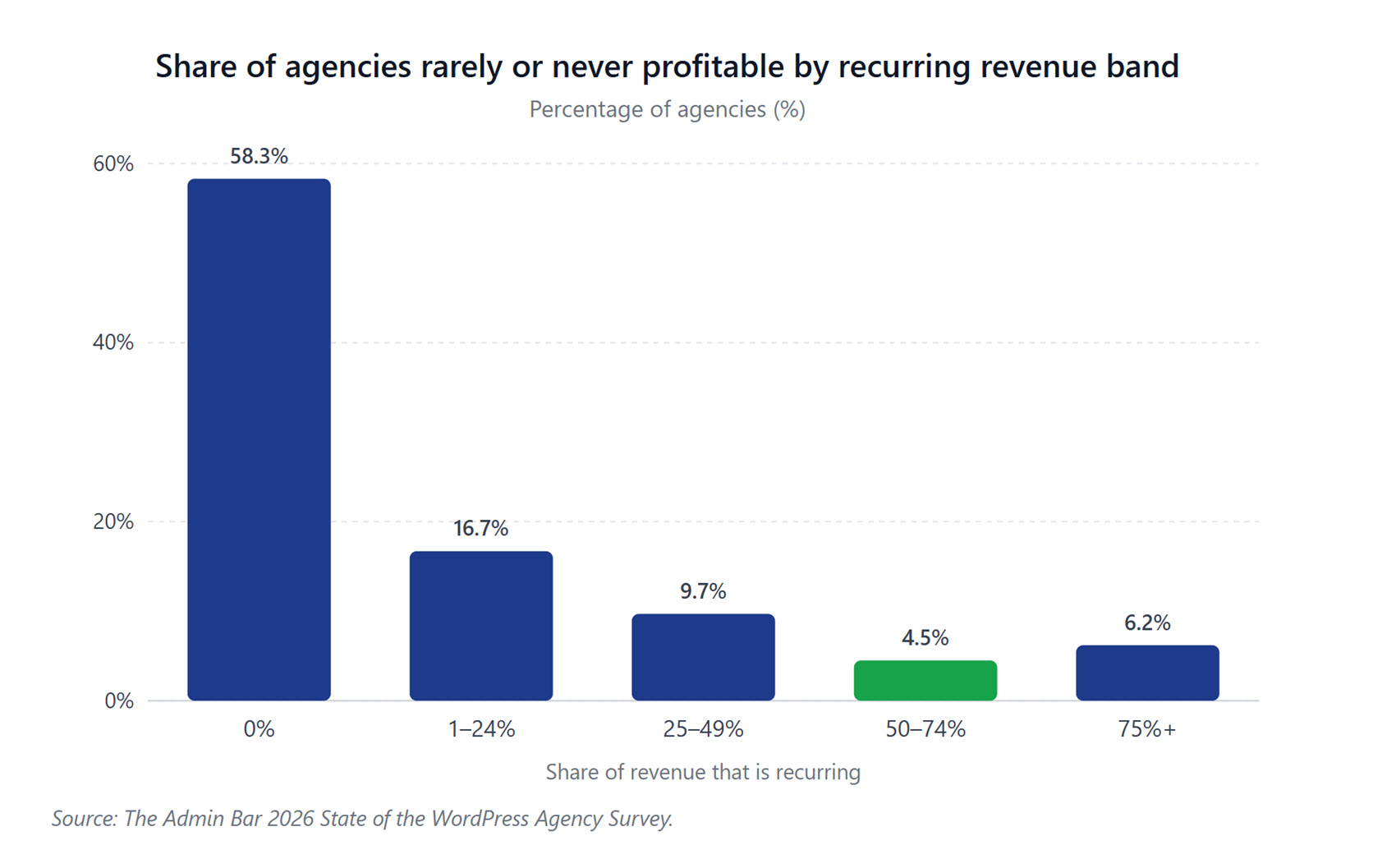
Agencies with recurring revenue above 25% are far less likely to report being rarely or never profitable, with the lowest unprofitability rate in the 50–74% recurring revenue band.
For a freelancer or small agency, that’s the difference between always chasing the next project and having a baseline to plan around.
However, the takeaway isn’t “go all-in on retainers.” Agencies in that same 50–74% band are also the most optimistic about 2026, with around 65% reporting confidence in their business direction. Unprofitability bottoms out and optimism peaks in the same range, indicating a sweet spot rather than a more-is-always-better curve.
It creates a more stable, more consistent business
Project work typically means feast-and-famine cycles, gaps between contracts, and constant pressure to find the next big client, while maintenance replaces those highs and lows with a steadier baseline.
The structural risk of project-only revenue is clearly evident in the Admin Bar data. When an agency’s top three clients account for 75% or more of revenue, they’re significantly less likely to reach $200K+ in revenue. As the report puts it, “a few big clients create more risk, not more stability.” A care plan business creates the opposite: a portfolio of smaller, predictable relationships across many sites, where no single client’s departure derails the month.
Day to day, the work itself also runs on a steadier rhythm. Updates happen on schedule, and monitoring catches issues before clients notice them. So what you’re offering is fundamentally different from reactive break-fix support, and that reliability is what keeps clients on the plan year after year.
It opens the door to higher-value work
Another benefit of offering maintenance services is that being inside client sites every month puts you in a position to spot work clients haven’t flagged: improvements that go beyond what’s covered in the care plan.
This could include SEO fixes, performance upgrades, content migrations, design updates, or accessibility enhancements.
Each one is easier to sell to a client who already trusts and pays you regularly than to a cold lead.
For a fuller picture of what a maintenance scope can actually include, the WordPress maintenance guide walks through the full set of tasks worth covering.
Common reasons agencies don’t make the most of maintenance
According to The Admin Bar’s 2026 survey, more than 9 in 10 WordPress agencies already offer some form of maintenance service. However, only around 35% of respondents earn 50% or more of their revenue from recurring sources.
Based on this data, the gap is between offering maintenance and making it a key part of the business, not between agencies that offer it and those that don’t.
These are the four reasons that gap usually exists.
They price it wrong
Most agencies underprice their care plans, often badly. A flat $50/month plan that includes “unlimited support” quickly becomes a margin killer. Every support request eats into the monthly fee, and the most demanding clients consume the most time at the same price as the easiest ones.
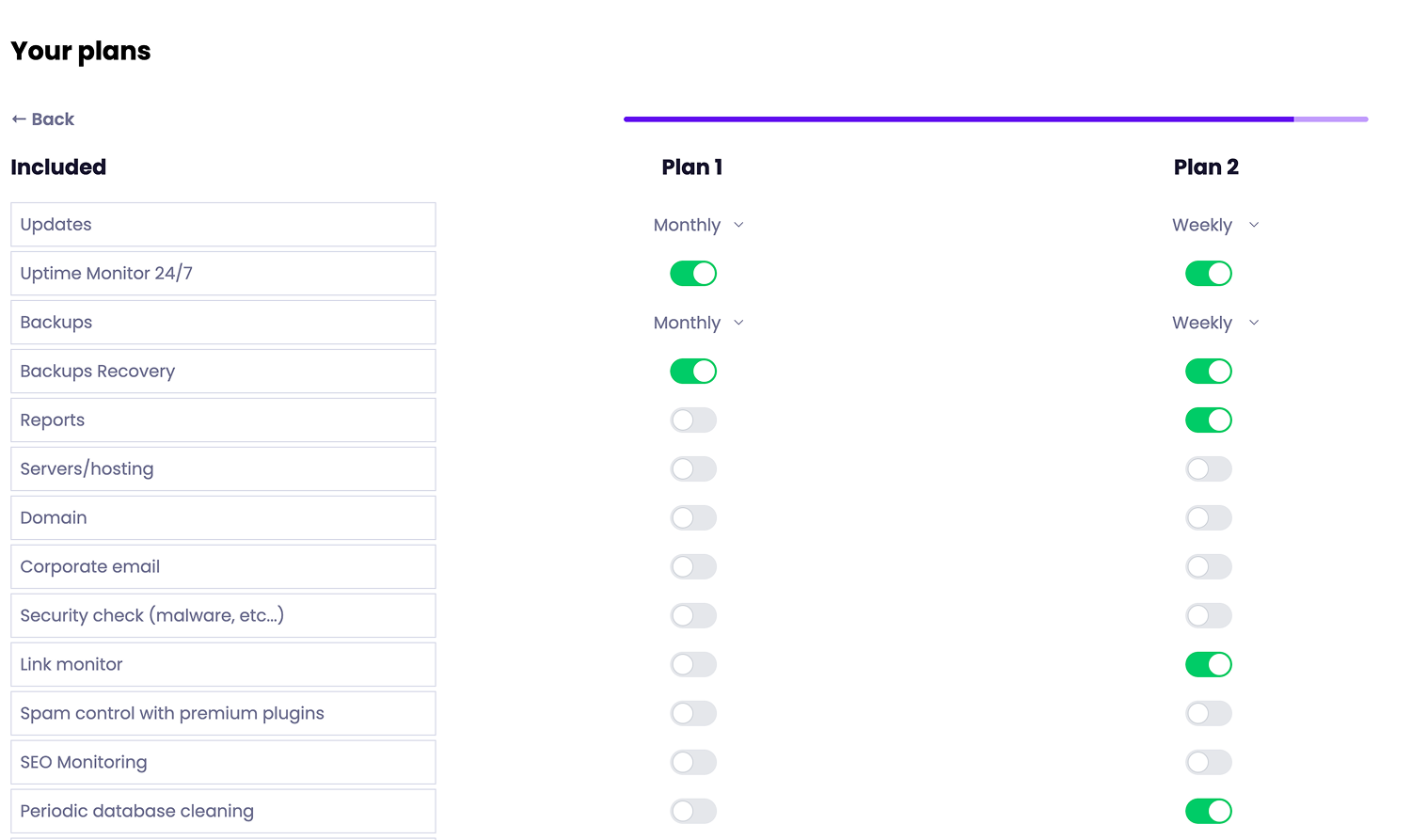
Tiered pricing solves this. Starter, standard, and pro plans give clients a real choice and protect your margins on either end. Multiple plans also reframe the conversation from “do you want maintenance?” to “which plan works for your site?” That’s a much easier question to close.
Pricing should reflect your scope, your time costs, and the actual value to the client, not what the cheapest competitor charges. Our free WordPress care plan calculator is a useful starting point.
Their scope is unclear
“Maintenance” without a defined scope can quickly become whatever the client asks for. This is how care plans turn into the worst kind of break-fix work: recurring revenue with project-level workload and no real margin protection.
A clear scope document covers three things:
- What’s included monthly: Updates, backups, monitoring, and a defined number of hours for small fixes.
- What triggers a separate quote: Redesigns, new features, content migrations, and anything outside the regular scope.
- What’s outside the plan entirely: Custom development and third-party integrations that need ongoing maintenance of their own.
That clarity protects both your margins and the client relationship. Clients know exactly what they’re paying for, and you know exactly what you’re delivering.
They lack the systems to deliver it efficiently
Capacity is the second-biggest factor limiting growth for WordPress agencies, cited by around 31% of respondents in the Admin Bar survey. When maintenance is delivered manually, the work scales with every client site you add, and that’s usually where the bottleneck appears.
Manually checking each client site, running updates, generating reports, and chasing alerts doesn’t scale past a handful of clients. By the time you’re managing 15 to 20 sites, the operational drag eats most of the margin.
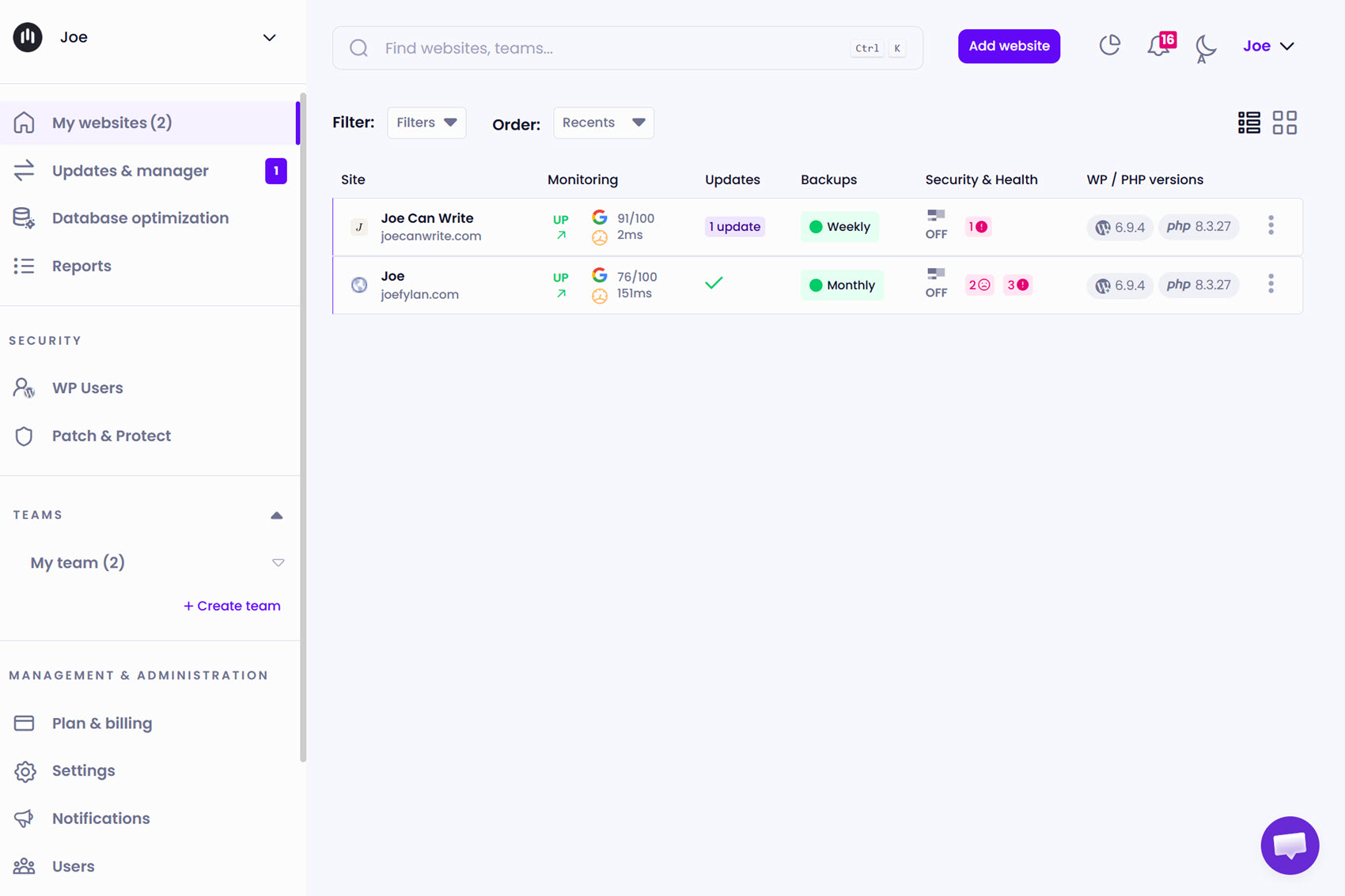
A central dashboard for backups, updates, uptime monitoring, and reporting changes the unit economics. Tools like Modular DS handle most of the repeatable work, including bulk updates with rollback, scheduled backups, uptime alerts, and branded client reports. This lets you take on more sites without working proportionally more hours per week.
They struggle to communicate the value
Some agencies hesitate to lead with maintenance in proposals because they’re not sure how to position it. Others prominently offer it but fail to close the deal because they struggle to communicate its value.
The reframe that tends to work is shifting the conversation from features (what’s in the plan) to outcomes: risk reduction, business continuity, and protection of the work the client already paid for. Sites without ongoing care don’t stay healthy forever, as issues can build up over time.
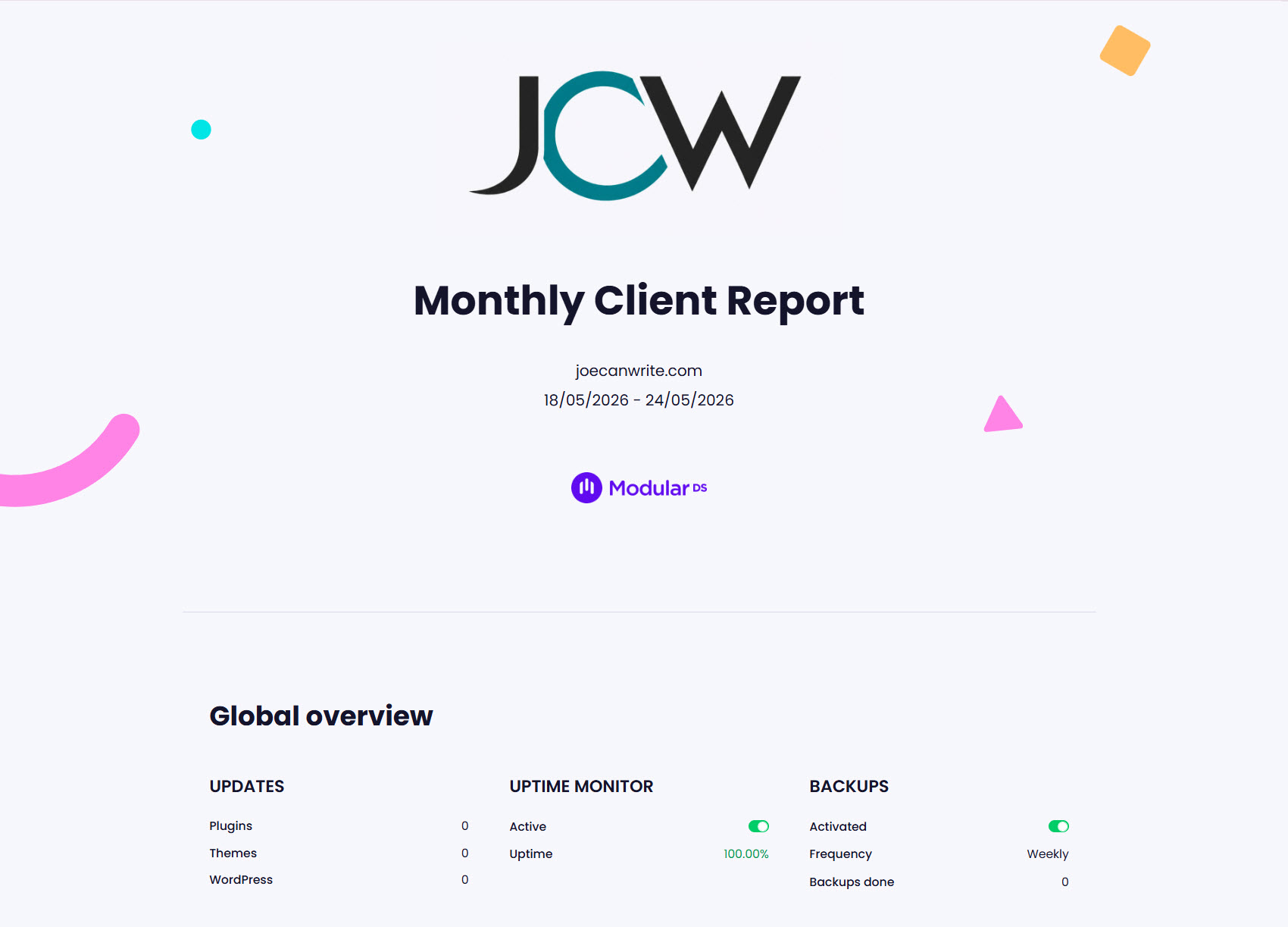
The other half of communicating value is showing it. Monthly maintenance reports covering what was updated, what was prevented, and what was monitored justify the recurring fee in the client’s mind, month after month. Our guide to creating WordPress maintenance reports walks through what to include.
For the full sales playbook, how to sell more WordPress care plans covers the conversation in depth.
Where WordPress maintenance services are heading
AI is already changing how WordPress maintenance services gets delivered. Smart update workflows, anomaly detection, automated visual regression checks, and AI-assisted client reports are appearing in maintenance tools, and agencies with a more positive view of AI are reporting more confidence about where their business is heading.
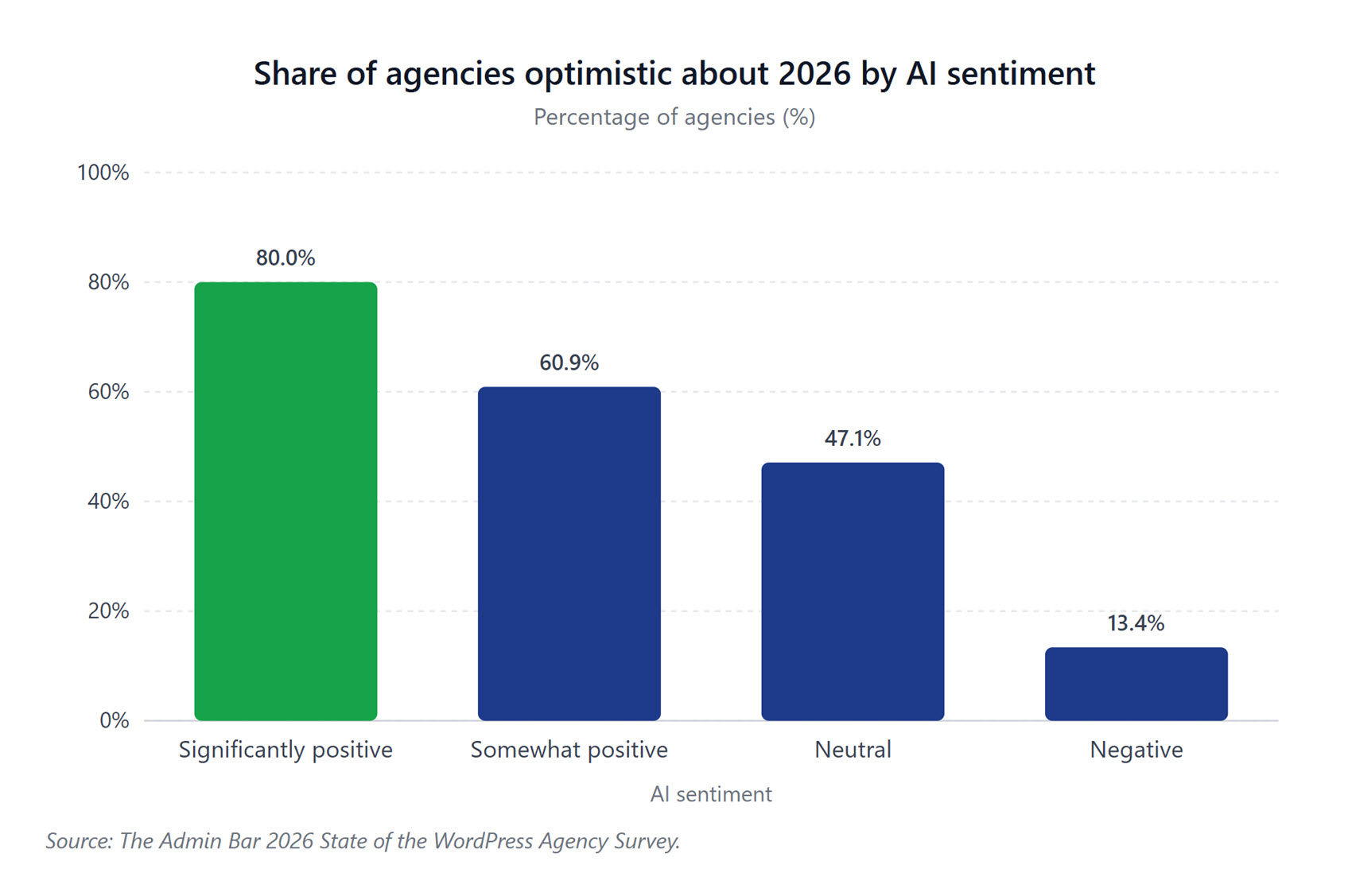
Around 73% of agencies say AI is positively impacting their efficiency or profitability. Among those with significantly positive AI sentiment, 80% report optimism about 2026, compared with just 13% of agencies with negative AI sentiment.
What this means for WordPress maintenance services is redistribution rather than replacement. Routine work gets automated; the value shifts to oversight, optimization, and the client relationship, which are the parts of the service clients pay for. Agencies treating maintenance as a strategic offer in 2026 are the ones positioned to benefit from this shift rather than be displaced by it.
Making WordPress maintenance services a real revenue line
If you’re ready to build a more stable, profitable WordPress business, treat maintenance as a core offering and address pricing, scope, systems, and communication head-on. Start by reviewing your current care plans, updating your scope documents, and setting aside time to implement efficient tools. This is your opportunity to step up and establish recurring revenue as the foundation for your agency’s growth.
Frequently asked questions
What should WordPress maintenance services include?
A typical WordPress maintenance service should include plugin, theme, and WordPress core updates, regular backups, uptime monitoring, security checks, performance monitoring, and client reports. Higher-tier plans can also include content updates, SEO checks, priority support, and a set number of small development tasks each month.
How much should I charge for a WordPress care plan?
Your pricing should reflect the scope of the plan, the time it takes to deliver, the risk you’re taking on, and the value to the client. Many freelancers and agencies use tiered pricing, with a lower-cost basic plan and higher-priced plans for clients who need more support, reporting, or hands-on work. The free care plan calculator is a useful starting point.
How do I sell maintenance to clients who don’t see the value?
Lead with the consequences of not having it (downtime, security breaches, SEO decline) and offer a tiered choice rather than a yes/no decision. The full playbook is in how to sell more WordPress care plans.
Can I run a maintenance business solo?
Yes. The main constraint is systems, not team size. A solo freelancer can offer maintenance profitably if the work is clearly scoped, priced correctly, and supported by tools like Modular DS that reduce manual effort across updates, backups, monitoring, and reporting.